


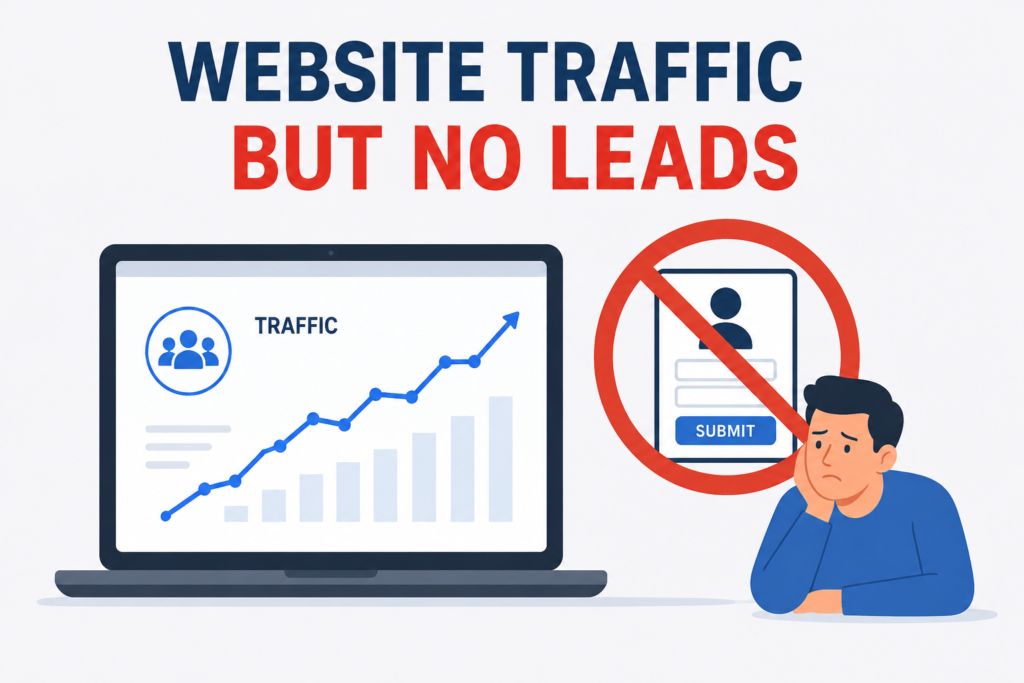
This is a big problem when it comes to marketing on the internet: website traffic but no leads. You have people visiting your website, but nobody is getting in touch with you. The number of times people are looking at your website is up. The number of times people are looking at your pages is going up every month. So why do you not have any sales now than you did six months ago?
This is a big problem when it comes to marketing on the internet: you have people visiting your website but nobody is getting in touch with you. It feels like you are doing everything right. You are putting things on your website you are near the top when people search for things on Google you are paying for ads. But nobody is calling you and nobody is filling out the form, on your website to get in touch with you.
The thing is, the number of people visiting your website and the number of people who want to buy something from you are not the thing and a lot of businesses make a mistake by thinking they are the same. Let’s figure out why you’re experiencing website traffic but no leads, and find a way to fix your website traffic and sales pipeline.
Read Other Related Blog – How to Start an E-Commerce Business, Market, and Grow Your Store
1. You’re Attracting the Wrong Audience
Not all website visitors are the same.
If your content shows up for information searches instead of searches from people ready to buy you’ll get a lot of curious visitors who aren’t looking to make a purchase.
For example a plumbing company that appears in search results for “how does a water heater work” will get visitors who are just researching not looking to hire a plumber. On the hand if the same company appears in search results for “emergency water heater repair near me” they will attract someone who is ready to book a service.
The solution is to take a look at your top pages in terms of traffic and compare them to your top pages in terms of conversions. If theres not overlap between the two it means you’re likely optimizing your content, for search queries that don’t align with your business goals.
2. Your Website Lacks a Clear Call to Action
When people visit a website they usually do not do anything on their own. The website needs to tell the visitors what they should do next. A lot of business websites make it hard for visitors to find their contact information. They use buttons that say things like “Learn More” which’s not very helpful. Sometimes they have a lot of things to click on all on the same page and this can be confusing for the visitor.
The buttons should say things like “Get a Free Quote” or “Book Your Consultation” so the visitor knows what they are getting. These buttons should be, near the top of the page so the visitor can see them away. If the page is long the buttons should be repeated in a way that makes sense. The visitor can still see them and know what to do next.
3. Your Value Proposition Isn’t Clear
When someone visits your website and they do not understand what your website does who your website is for and what makes your website different from others within five seconds they will leave your website. If your website has an generic message this is one of the main reasons people visit your website but do not do what you want them to do.
The fix for this problem is that your website headline should answer three questions right away: What does your website offer to people? Who is your website for? Why should people choose your website of other websites that are similar, to yours? You should not use words that people do not understand and you should focus on what people want to get from your website.
4. There’s a Trust Gap
This is one of the biggest reasons businesses experience website traffic but no leads. People won’t give their contact details or spend money with businesses they don’t trust. If your website doesn’t have any customer reviews, ratings, success stories, credentials or social proof visitors won’t think you’re reliable. Even if you offer services.
The solution is to add customer feedback, results, client names and logos or trust symbols from other companies. Video reviews and detailed success stories with facts work better, than general praise.
5. Your Site Is Slow or Not Mobile-Friendly
Most people use their phones to look at websites these days. If your website takes long to load people will leave. They will also get frustrated if they have trouble tapping on things with their fingers.
The thing to do is check how fast your website is on a phone. You can use a tool to see how fast your website loads. You should also make your pictures smaller so they load faster. Then try using your website on a phone not just a computer that is made to look like a phone. Try everything from getting to the website to filling out a form to make sure it all works well on a device, like a phone.
6. Your Lead Capture Process Is Too Complicated
Long forms can really turn people off. When you ask for much information right away it can scare off people who are actually interested, in what you have to offer.
Every extra question you ask reduces the chances of them actually going through with it.
The fix is simple:
* Keep your forms short, name, email and phone number.
Offer something risk first
* like a free consultation
* or a downloadable guide.
Don’t ask them to buy away.
7. You’re Not Retargeting or Following Up
Most people who visit your website will not buy anything on their visit. Studies have shown that people need to see your website or product times before they are ready to buy. If you do not have ads that follow people who visited your website or a way to collect email addresses or a plan to follow up with them you will lose people who were interested but not ready to buy
The fix is to use retargeting ads for people who visited your website but did not buy anything and to use popups that appear when someone is about to leave your website or to offer something in exchange, for their email address so you can send them more information over time and help them get to know your product, which is retargeting ads and your website and your product better.
8. Your Content Doesn’t Guide Visitors Toward Conversion
When people write blog posts and make resource pages they are really good at getting people to visit their website.. If these posts and pages do not tell the readers what to do next they are not very useful. Someone might read an article think it is really helpful and then just close the website.
If you’re dealing with website traffic but no leads, the following checklist will help identify the biggest conversion problems on your site.
Turning Traffic Into Leads: A Quick Checklist
- Match content to buyer intent, not just search volume
- Simplify and clarify your CTAs
- Sharpen your homepage value proposition
- Add visible trust signals and social proof
- Optimize site speed and mobile experience
- Shorten lead capture forms
- Set up retargeting and email nurture sequences
- Add conversion paths inside blog content
Traffic is the step. It is necessary but it is not what we are trying to achieve. If you are still having trouble getting people to become leads after they visit your website the problem is usually not that people cannot find your website it is that your website is not doing a job of turning Traffic into leads. The main goal of your website is to turn Traffic into people who trust your website enough to contact you. Once you improve your messaging, trust signals, CTAs, and user experience, the website traffic but no leads problem becomes much easier to overcome.
Frequently Asked Questions
Q1: How much traffic do I need before I should expect leads?
There’s no universal number — a website with 500 highly targeted monthly visitors can outperform one with 10,000 unfocused visitors. Focus on conversion rate (leads divided by visitors) rather than raw traffic volume.
Q2: What’s a good website conversion rate for a business site?
Averages vary by industry, but most business websites see conversion rates between 2% and 5%. If you’re significantly below that, it’s a sign something in your funnel needs attention.
Q3: Should I focus on SEO or conversion rate optimization first?
If you already have steady traffic but few leads, fix conversion issues first — it’s usually faster and cheaper than driving more traffic to a leaky funnel. If traffic itself is low, balance both efforts simultaneously.
Q4: What’s the most common cause of website traffic but no leads?
It’s usually a mismatch between the keywords driving traffic and actual buyer intent, combined with unclear CTAs. Fixing search intent alignment and CTA clarity resolves this issue for most businesses.
Q5: Can paid ads fix a no-leads problem?
Not on their own. Paid ads increase traffic volume, but if your website has the conversion problems described above, ads will simply amplify the same low conversion rate at a higher cost.
Q6: How do I know which part of my funnel is losing leads?
Use analytics tools to track behavior flow — where visitors land, how far they scroll, and where they drop off. Heatmaps and session recordings can also reveal exactly where people lose interest or get confused.
Q7: Is it better to have one CTA or multiple CTAs per page?
Generally, one clear primary CTA per page performs best. Multiple competing CTAs create decision fatigue and can reduce overall conversions, even if they seem to offer more options.
Q8: How long does it typically take to fix a traffic-without-leads problem?
Simple fixes like CTA clarity or form simplification can show results within weeks. Deeper issues, like trust-building or content realignment with buyer intent, may take one to three months to fully reflect in conversion data.